Health and Safety Policy for Flat Clearance Cricklewood
 This Health and Safety policy outlines the commitment of Flat Clearance Cricklewood to provide safe, lawful and efficient flat clearance and rubbish removal services across our stated rubbish company service area. The purpose of this policy is to protect the health and welfare of employees, contractors, clients and the public while maintaining high standards in all flat clearance activities. It sets out responsibilities, operational controls and monitoring arrangements that apply to every job, from small domestic flat clearing to larger multi-room clearances and rubbish disposal tasks.
Scope and Objectives
This policy applies to all staff, sub-contractors and temporary workers engaged in flat clearance services in Cricklewood and the surrounding service area. Our objectives are to: minimise risk of injury or ill health; ensure correct handling and disposal of waste; comply with relevant health and safety legislation and industry best practice; and continually improve safety performance. The policy covers risk assessment, safe systems of work, vehicle and equipment use, manual handling, hazardous waste management and emergency procedures. Core principles:
- Risk assessment first: Identify hazards and put controls in place before work starts.
- Competence: Ensure staff are trained and competent for rubbish clearance tasks, including waste segregation, lifting and safe use of tools.
- Safe equipment: Maintain vehicles and equipment to a safe standard and remove defective items from service.
Responsibilities
Management has overall responsibility for implementing and maintaining this policy, ensuring adequate resources, appointing competent supervisors and regularly reviewing procedures. Supervisors and team leaders are responsible for communicating safety measures, ensuring method statements are followed and arranging appropriate personal protective equipment (PPE). Employees must follow safe work instructions, report hazards, and participate in training. Sub-contractors engaged for specialist clearance work must comply with this policy and provide evidence of their own health and safety arrangements before starting work. Hazard identification and risk control — Before each job our team completes a site-specific risk assessment that considers: trip and fall hazards, manual handling loads, sharps and contaminated items, asbestos risk indicators, electrical hazards, and access restrictions. Controls include using mechanical aids for lifting, two-person lifts for bulky items, sealed containers for hazardous materials, safe routes for waste transfer and exclusion zones where debris is present. When asbestos or other specialist hazards are suspected, work is suspended and qualified specialists are engaged.
Training and competence are central to safe operations. We provide induction, periodic refresher training and job-specific instruction covering manual handling, vehicle loading, PPE use, and safe disposal of household and commercial waste. Training records are maintained and reviewed. Employees are encouraged to raise concerns and suggest improvements through formal channels. Personal protective equipment such as gloves, eye protection, high-visibility clothing, and respiratory protection where required are provided and must be used in accordance with risk assessments.
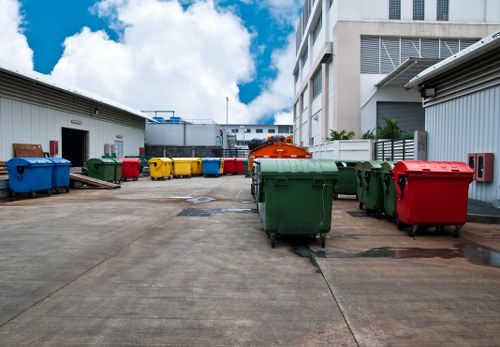
Vehicles and equipment used for flat clearance and rubbish removal are inspected daily and serviced at scheduled intervals. Load security, weight limits and safe vehicle access are enforced to reduce the risk of road and site incidents. Tools such as trolleys, harnesses and lifting straps are regularly checked. Waste segregation is practiced on-site: recyclable materials, general waste, electricals (WEEE), and hazardous items are separated and placed in appropriate containers for lawful disposal or specialist treatment.
 Incident reporting and emergency procedures are clearly defined. All accidents, near misses and significant incidents are reported promptly, recorded and investigated to identify root causes and corrective actions. Emergency arrangements include first aid provision, contact with emergency services, safe evacuation routes and communication protocols. We commit to cooperating with enforcement bodies and providing required documentation during inspections.
 Monitoring, audit and continual improvement: this policy is reviewed annually and after any significant incident or change in operations. Performance is measured using leading and lagging indicators such as training completion rates, incident frequency, audit findings and corrective action closure. Flat clearance teams are supported through toolbox talks, safety briefings and routine supervision to embed safe working practices. The company will adapt the policy to reflect changes in legislation, industry standards, and evolving service area needs.
Final note: This Health and Safety policy is a core operational document for Flat Clearance Cricklewood and applies to all aspects of our rubbish clearance and flat clearing services. It is part of our legal duty to protect workers and the public and our ongoing commitment to responsible rubbish removal across our service area. Compliance with this policy is mandatory for all personnel; failure to adhere may result in disciplinary action or removal from the workplace.
Signed on behalf of Flat Clearance Cricklewood